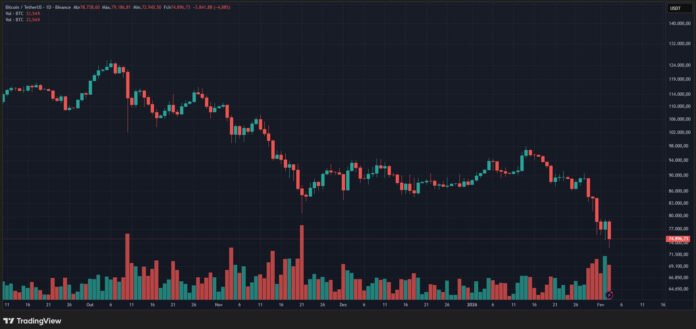
Bitcoin fell around 8% on Feb. 3, briefly losing the $73,000 level.
A quick rebound took prices to $74,500 as of press time, dampening the intraday correction to 5.8%. The decline marks the lowest price point in the President Donald Trump administration and the weakest level since the November 2024 Presidential Election.
The selloff pushed Bitcoin as low as its March 2024 all-time high of $73,500, a level that held through the early stages of the decline but ultimately gave way under sustained selling pressure.
The move revived a cluster of support zones that traders have monitored as critical technical thresholds for nearly a year.
Macro risk-off drives crypto lower
The crypto weakness is linked to broad risk-off sentiment across markets, sparked by Trump’s nomination of Kevin Warsh as Federal Reserve chair.
Warsh’s selection stoked concerns about a more hawkish policy mix and tighter financial conditions, pressures that historically weigh on high-beta assets, including cryptocurrencies. A stronger dollar, which typically accompanies such expectations, compounds the headwind for digital assets. The current dollar weakness, however, makes this decline even more painful.
Microsoft’s Azure growth disappointment added to the selling pressure, souring broader risk sentiment and triggering cross-asset contagion.
The AI trade wobble demonstrated how crypto remains vulnerable to spillover effects from growth-sensitive technology sectors, particularly when positioning is stretched and liquidity is thin.
Leverage unwind amplifies decline
CoinGlass data shows over $2.5 billion in Bitcoin liquidations in recent days, turning what began as a macro-driven selloff into a cascade of forced selling.
Thin weekend liquidity exacerbated the selloff that began at $84,000 on Saturday, according to a Bitfinex note.
The combination of macro triggers and leverage unwinding created conditions in which relatively modest initial selling pressure could force far larger moves, as stop-losses and margin calls compounded the decline.
Additionally, institutional flows in 2026 have been uneven.
Exchange-traded fund (ETF) inflows, often followed by outflows during volatility episodes, suggest tactical rebalancing rather than aggressive dip-buying, leaving prices exposed as liquidation pressure accelerates.
The absence of consistent institutional demand meant there was no meaningful buffer when forced selling began.
Galaxy Digital research also noted that near-term catalysts appear scarce, with diminished odds of legislative progress on market structure acting as a narrative headwind.
Without clear positive drivers on the horizon, traders lack the conviction to step in aggressively during drawdowns.
Critical support and resistance levels
Bitcoin now trades within a tightly watched technical range.
The $73,500 level from 2024 and the Feb. 3 intraday low of $72,945 form the immediate support zone.
IG Markets identifies a broader support band between $73,581 and $76,703, an area associated with prior cycle highs and 2025 lows that has been tested multiple times over the past year.
CryptoSlate also identified several support and resistance levels for 2026 in Akiba’s bear market analysis.
A daily close below this band would increase the probability of follow-through selling toward the next support cluster between $72,757 and $71,725. If that zone fails to hold, the July 2024 peak of around $70,041 becomes the next major downside waypoint.
On the resistance side, Bitcoin’s reclamation of the 2024 all-time high of $73,500 indicates that buyers are willing to defend the recent breakdown level. The April 2025 trough zone around $74,508 now acts as resistance after previously serving as support.
Above that, minor resistance sits at $78,300, with the November 2025 low of $80,620 and the psychological $80,000 level forming the next meaningful barrier.
Distinguishing bounce from recovery
A single-day rebound does not constitute a durable bottom.
Historical patterns suggest that sustainable recoveries typically require at least two conditions: repeated daily closes above the $74,500 level, converting the April 2025 reference zone from resistance to support, and evidence that liquidation pressure has faded following the $2.56 billion forced-selling wave.
Without these confirmations, rallies risk becoming dead-cat bounces into overhead resistance as sellers use strength to exit positions.
ETF flows must stabilize beyond isolated green days, consistent with the tactical rather than aggressive institutional behavior.
Two near-term scenarios
If Bitcoin holds the $73,000 to $73,445 support zone and reclaims $74,500, the path of least resistance becomes a grind toward $78,300, then the $80,000 to $80,620 range.
This scenario requires both technical follow-through and the absence of new macroeconomic headwinds.
Alternatively, a daily close below the $73,581 lower band increases the odds of continuation selling into the $72,757 to $71,725 zone, with the $70,000 level as the next major psychological and technical waypoint.
This scenario becomes more likely if liquidation pressure remains elevated or if macro conditions deteriorate further.
Bitcoin’s decline below its 2024 all-time high after nearly a year of holding that level as support constitutes a technical breakdown, shifting the burden of proof to buyers.
The combination of macro risk-off sentiment, leverage unwinding, and tactical institutional flows created conditions in which support levels that had held for months gave way within hours.